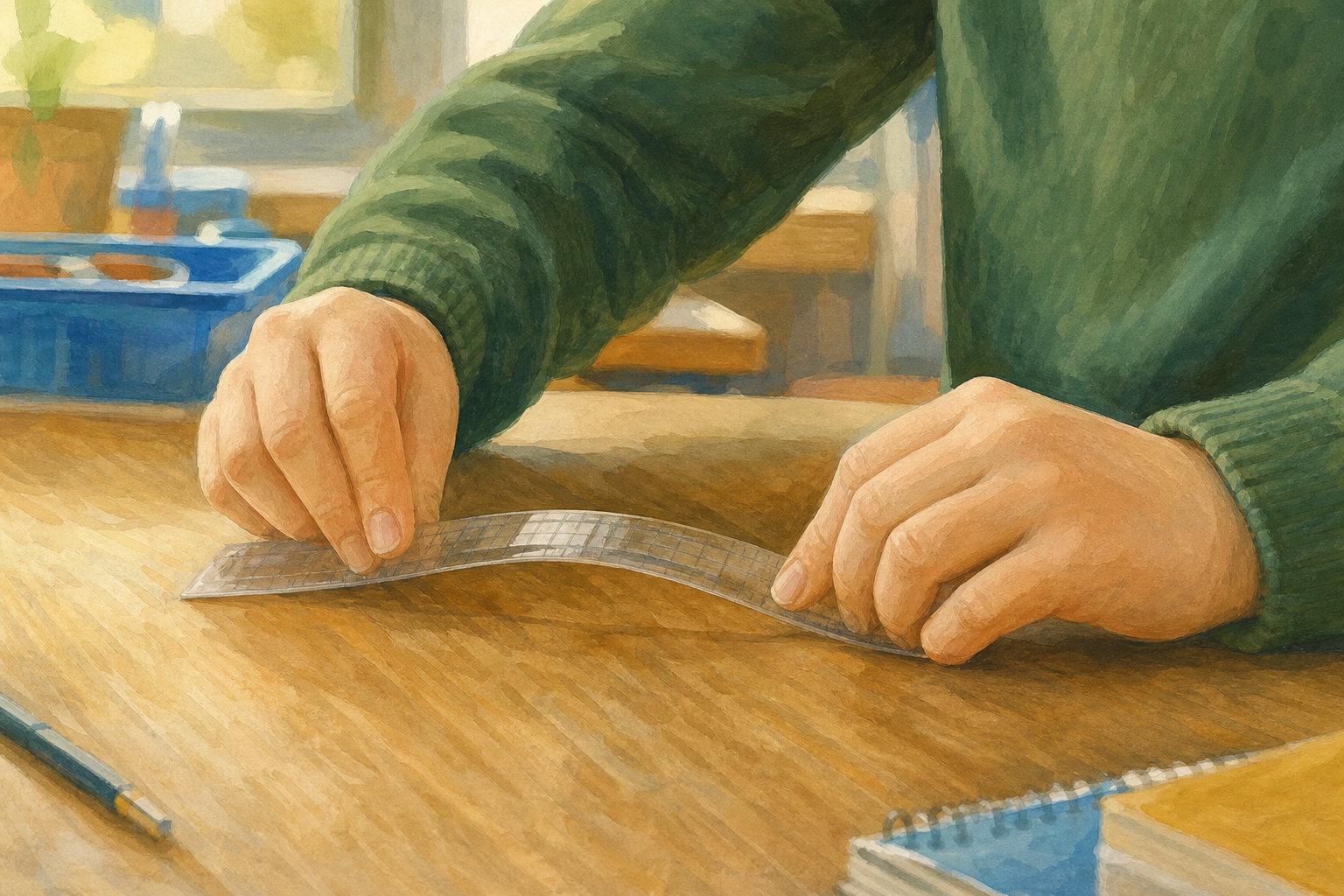
 The teacher holds up a plastic ruler. Can two fingers bend it when it lies flat? What happens when the same ruler stands on its thin edge?
Why might builders care which way round a beam is fitted?
When the teacher stands the ruler tall on its thin edge, that up-down size is its depth. The thinner side-to-side size is its width.
A beam is a long piece that carries a load across a gap or holds something up. Orientation is which way round the beam is turned when it is fitted.
Does the same beam resist bending better when it is deep, or when it is wide?
We will bend a ruler, a strip of card and a lolly stick two ways: flat, then on edge. Which way will be harder to bend? Talk with your group and be ready to say why.
First watch the teacher model one full test with a ruler. Then, in your group, bend the ruler, the card strip and the lolly stick flat, then on edge. Use a gentle two-finger push. Your group decides how you will judge which way is harder: by how the push feels, or by how far each piece bends. Bend gently only. Stop before anything creases or snaps. On your Investigation Journal page, record for each material which orientation was harder to bend.
Where we measure: Stay in the classroom and agreed nearby indoor spaces. Do not climb or move furniture.
What to do: In your group, measure at least two beams you can reach safely (three if you have time). Name which way each beam is fitted first, then measure.
What to write on your Investigation Journal page for each beam:
- the object
- orientation (how it is fitted)
- depth in millimetres
- width in millimetres
Be ready to share your readings with the class.
Unlock the full learning experience
You're previewing this lesson. Get full access to this lesson and hundreds more — each one ready to teach, with interactive activities, printable resources and pupil progress tracking built in.
This lesson is copyright of DigitalSkills.org 2017 - 2025. Unauthorised use, copying or distribution is not allowed.