 Put one hand where you think your heart is. Now point to where you think your brain is. After lunch, where do you feel the food sitting?
Today we will find out the names of five main organs, where each one sits, and the job each one does.
 Point with me, one organ at a time.
Brain — point to your head. Job: the control centre that thinks and tells your body what to do.
Heart — hand on your chest, a little to the left. Job: the pump that moves blood around.
Lungs — both hands on your chest. Job: two soft, spongy organs that fill and empty when you breathe.
Stomach — hand on your upper tummy. Job: the stretchy bag that holds food.
Intestines — hand on your lower tummy. Job: long tubes that finish the food job.
Which organ do you think sits highest in the body?
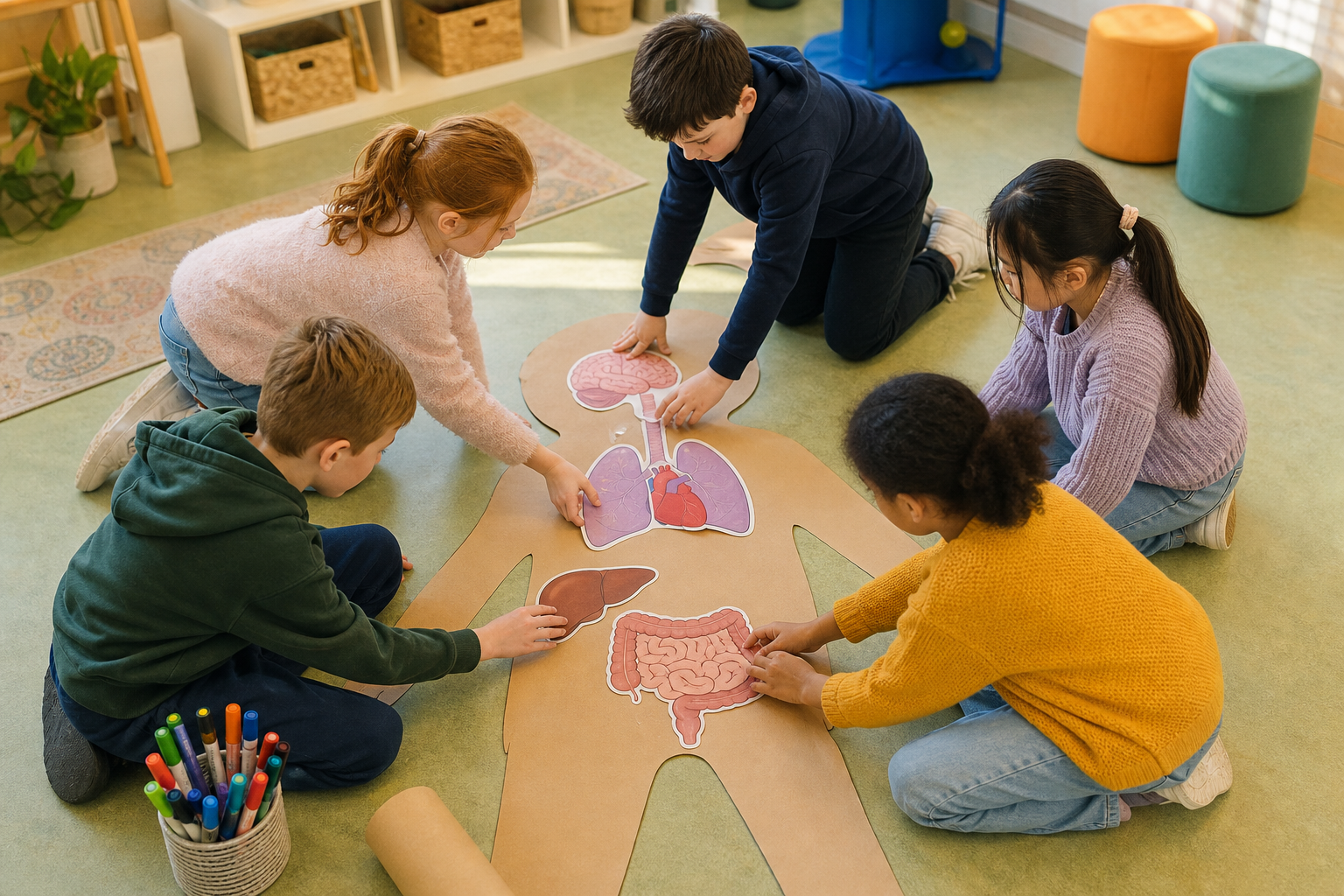 We will draw carefully around one volunteer on the big paper to make a life-size body outline. Then a few pairs will place the five organ cards — brain, heart, lungs, stomach, intestines — where each organ really sits.
Everyone else is on the investigation team too: watch each placement, say if you agree or would move it, and help say the organ's job when the card goes down. Are the chest organs higher than the tummy organs?
On the board is a body picture with five labels: brain, heart, lungs, stomach, intestines. Help drag each label to the matching part. The brain goes in the head, just as we placed it on our floor map.
Which label goes to the pump a little to the left of centre? Which two labels share the chest?
Main organs of the body
On your Investigation Journal page, draw a simple body outline and put the five organs in roughly the right places. Label each one: brain, heart, lungs, stomach, intestines (the words are on the board to copy).
For at least two organs, write or say one short job. You may whisper a job to your teacher instead of writing every one.
Unlock the full learning experience
You're previewing this lesson. Get full access to this lesson and hundreds more — each one ready to teach, with interactive activities, printable resources and pupil progress tracking built in.
This lesson is copyright of DigitalSkills.org 2017 - 2025. Unauthorised use, copying or distribution is not allowed.