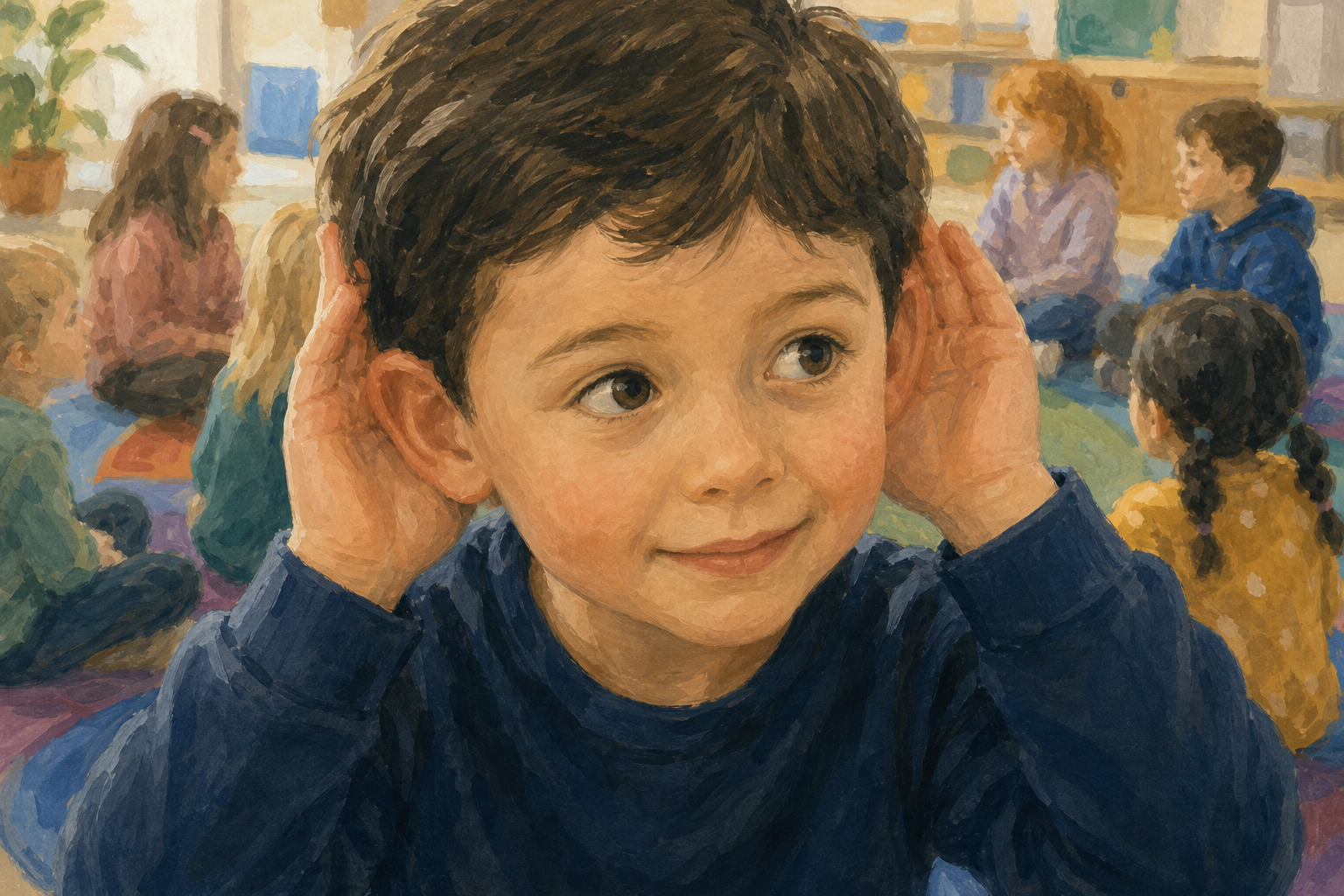
 Close your eyes for a moment. What can you still hear? Now wiggle your fingers. What are your hands good at?
Today we find out the special jobs our body parts do.
Today's word: job — what a body part is for.
What job do you think your ears do? What about your legs?
Look at the child figure on the board. Help put the five labels in the right places: head, arms, hands, legs and feet.
Eyes, ears and nose live in our head. When we name a job like hearing or seeing, point to the head on the figure, then point to that part on your own face. For other jobs, point to the part on the figure and on your own body.
Our body parts
We move around five action spots. At each spot, look at the body-part picture, show its job with your body (like pretending), and say the job out loud. Your teacher will show the first action.
Listen for the signal before you move to the next spot.
On your table you have four body-part cards and four job cards. Start with one body-part card you know. Find the job card that belongs with it.
When your pair is ready, say the match: Ears are for hearing.
On your Investigation Journal page, show one body part matched with its job.
Draw the part and the job. If you like, add a word or label.
Let's share. Which body part and job did you match? Point to it on your body as you say the job, like My hands are for holding.
Our legs and feet work hard when we run, kick, and dance — who helps us look after bodies that do those jobs?
Body parts have jobs. We matched parts to jobs and showed one match in our journal.
Cards in the pack, journals closed, gentle feet back to the carpet.
Unlock the full learning experience
You're previewing this lesson. Get full access to this lesson and hundreds more — each one ready to teach, with interactive activities, printable resources and pupil progress tracking built in.
This lesson is copyright of DigitalSkills.org 2017 - 2025. Unauthorised use, copying or distribution is not allowed.