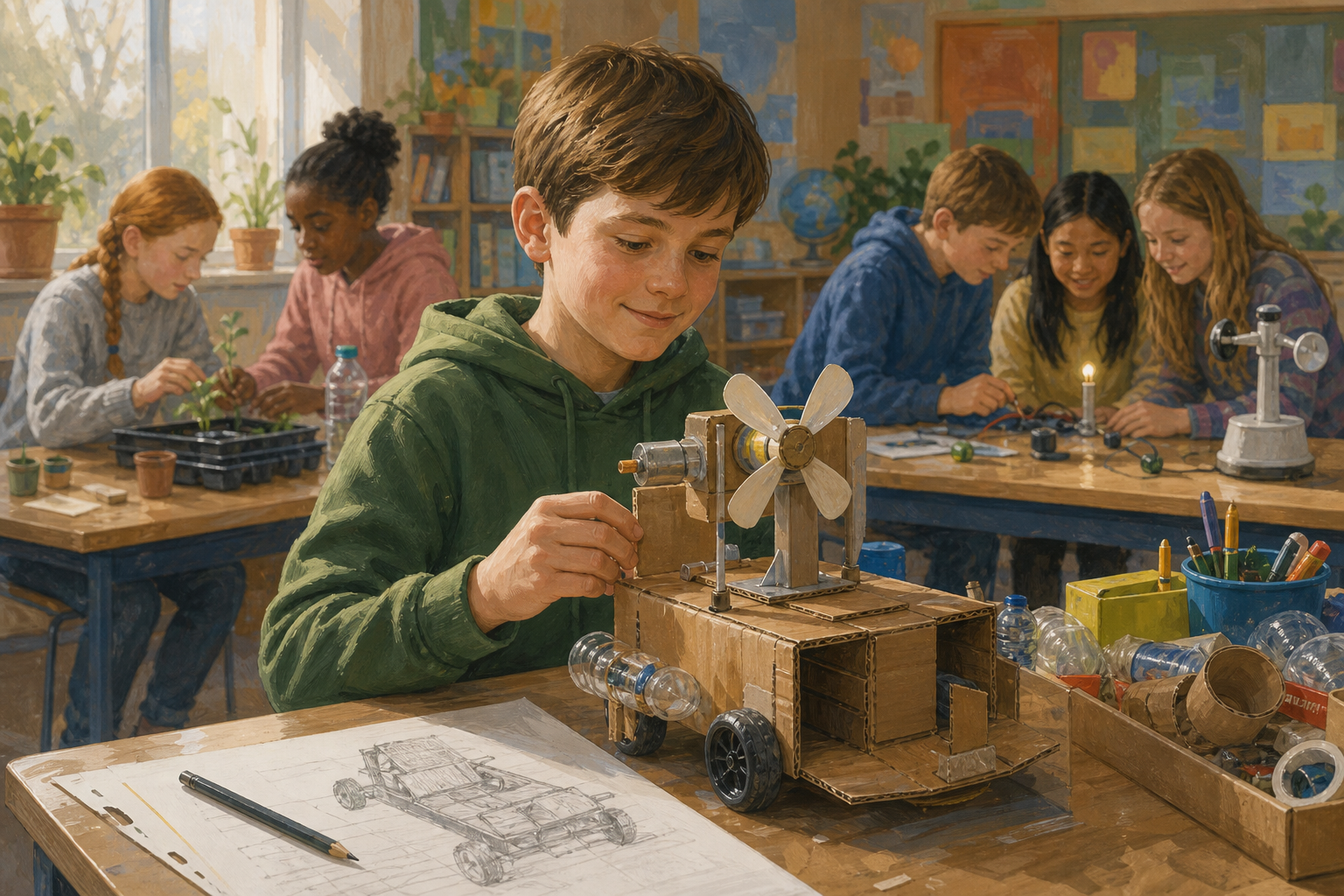
 Bring out the model you built earlier in this project. Whether you built a bag hook for the cloakroom, a shelter for the yard toys, or another fix for a school problem, today the question is the same: does it work, what does the evidence show, and how will we explain the whole process to the class?
Test your model against the success criteria on your Design Brief. Work through these beats in order:
- Read your success criteria aloud as a group.
- Set up and run the test exactly as you planned in Part 1. Change nothing mid-way.
- Jot Trial 1 and Trial 2 (a number or yes/no) on your Design Brief results space or a scratch note. Your Investigation Journal page stays closed until the next step.
- Write only what you see, not what you hoped for.
You will write the fuller conclusion on your Investigation Journal page in the next step. Do not fill an on-screen table during the test.
On your Investigation Journal page, record what the test showed, whether the model met the brief, and one thing you would change next. Keep what you saw separate from what you think it means. Use the Trial 1 and Trial 2 notes you took during the test.
Each group, count how many of your success criteria the model met and be ready to call out that total. We will enter every group's number on the class chart on the board. When all the bars are up, look at the pattern carefully: groups had different problems and criteria, so a tall bar is not automatically the "best" design. Which bars are tallest, what design choices sit behind them, and could a shorter bar still be a strong result for a harder brief?
How many success criteria did each model meet?
Every group presents for about 45 seconds. Show your model. Name the problem, one design choice, what the test showed, and one next step.
If you are listening: after every two groups, the class offers one clear comment or one question. Use: One thing that was clear… or One question I still have… Keep it tight so the whole class gets a turn.
Unlock the full learning experience
You're previewing this lesson. Get full access to this lesson and hundreds more — each one ready to teach, with interactive activities, printable resources and pupil progress tracking built in.
This lesson is copyright of DigitalSkills.org 2017 - 2025. Unauthorised use, copying or distribution is not allowed.