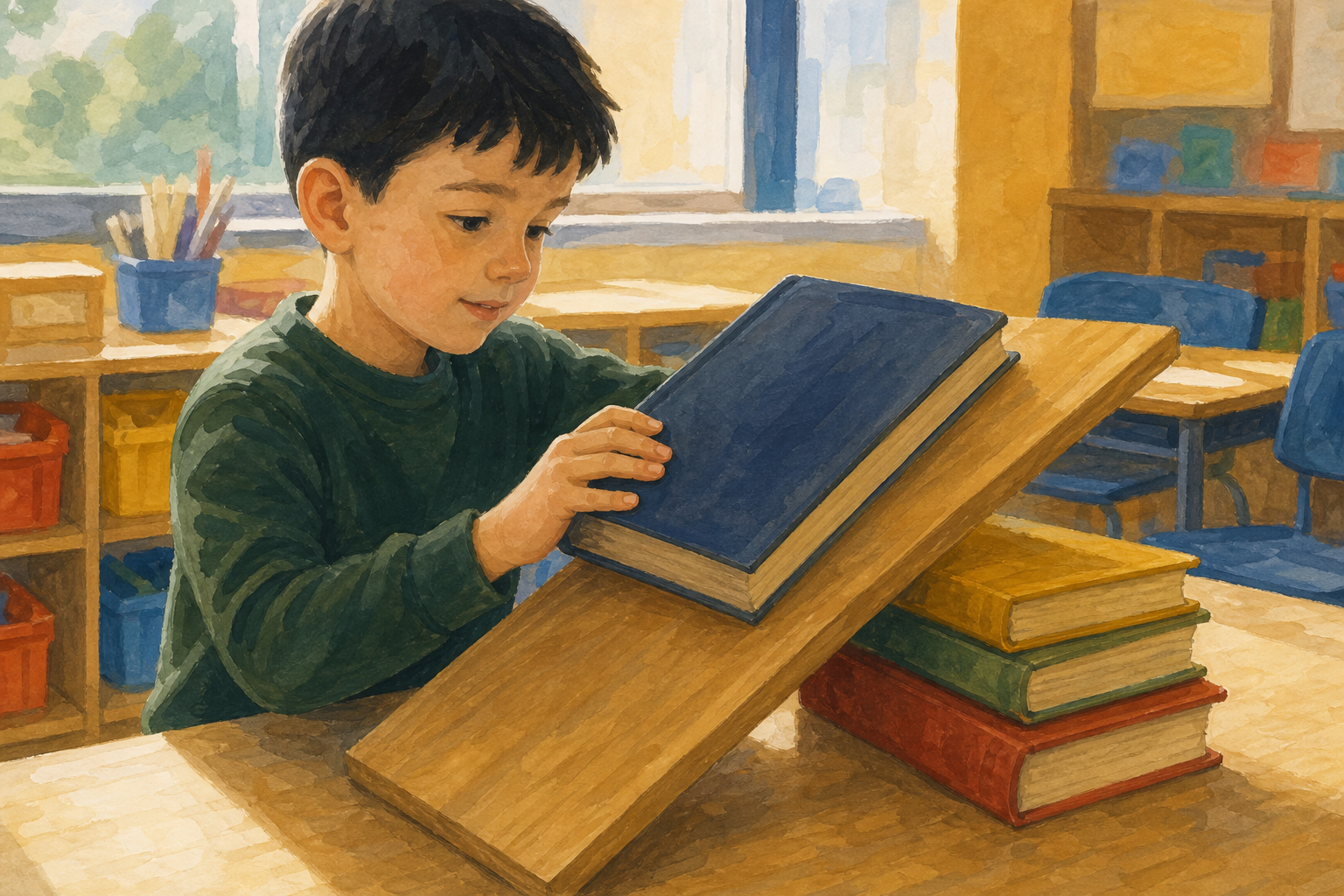
 Have you ever pushed a heavy bag up a sloping path instead of lifting it straight onto a step? Which felt easier?
Today we will feel how two simple machines, a ramp and a lever, help a small force do a big job.
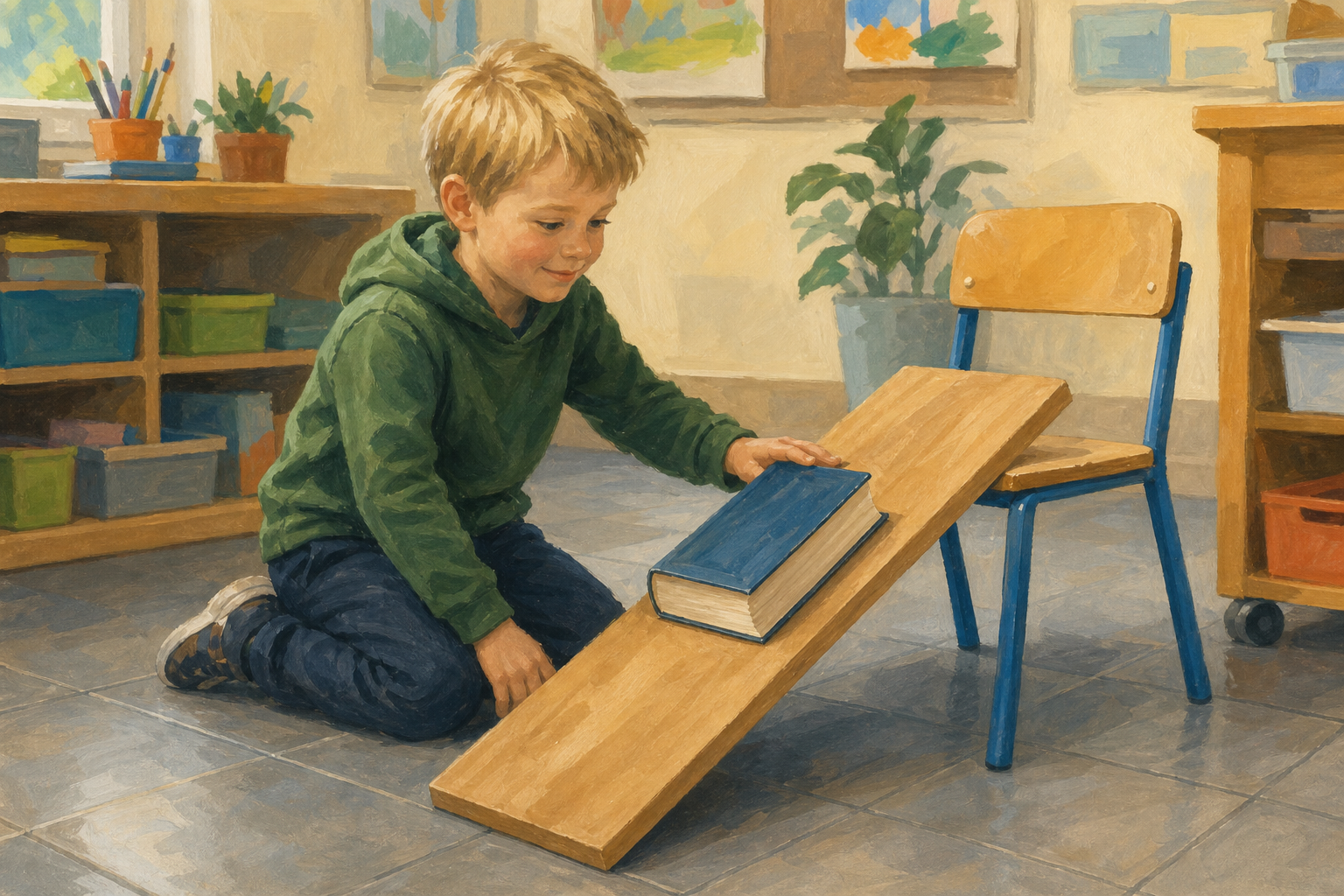 I wonder whether a slope or a tipping bar can make a heavy book feel easier to lift.
A ramp is a slope that makes a lift feel gentler. A lever is a stiff bar that rests on something (like a marker) and tips to lift a load.
Effort means how hard the push feels.
Which do you think will feel easier: lifting a book straight up, or sliding it up a ramp? Could a stiff bar help us lift with one finger?
In your group, set up two simple machines from the kit on your table.
Ramp: lean the smooth board from the desk up onto a low stack of books so the slope is gentle. Check it is steady.
Lever: rest the wooden ruler across the marker or eraser so it can tip like a seesaw. Put the rest nearer the book end. Place the book on the short end. The end with no book is the free end: the end you will press.
When both are ready, hands up and wait for the ready signal so we can check together.
We are investigating: How does lifting with a ramp or a lever compare with lifting straight up?
Effort means how hard the push feels.
First, say your prediction out loud to your group: which of the three ways will feel easiest, and why?
Then try each test in order:
- Straight lift: lift the book straight up from the desk to the height of your ramp top. Notice how hard the effort feels.
- Ramp: slide the same book gently up the ramp to the same height. Notice how hard the effort feels now.
- Lever: with the book on the short end, press the free end (the end with no book) with one finger until the book rises. If it will not rise, slide the rest a little closer to the book and try one finger again.
Keep the same book and the same height each time so the comparison is fair.
Think carefully about what your hands and arms noticed.
For each way of lifting (straight up, up the ramp, and with the lever), talk about:
- Did it feel hard, medium or easy?
- Did you use one hand, two hands, or one finger?
- Did the book travel a short way or a longer way?
Then, on your Investigation Journal page or plain paper, write and draw what you felt for each way, and write one sentence about which machine helped most.
Unlock the full learning experience
You're previewing this lesson. Get full access to this lesson and hundreds more — each one ready to teach, with interactive activities, printable resources and pupil progress tracking built in.
This lesson is copyright of DigitalSkills.org 2017 - 2025. Unauthorised use, copying or distribution is not allowed.