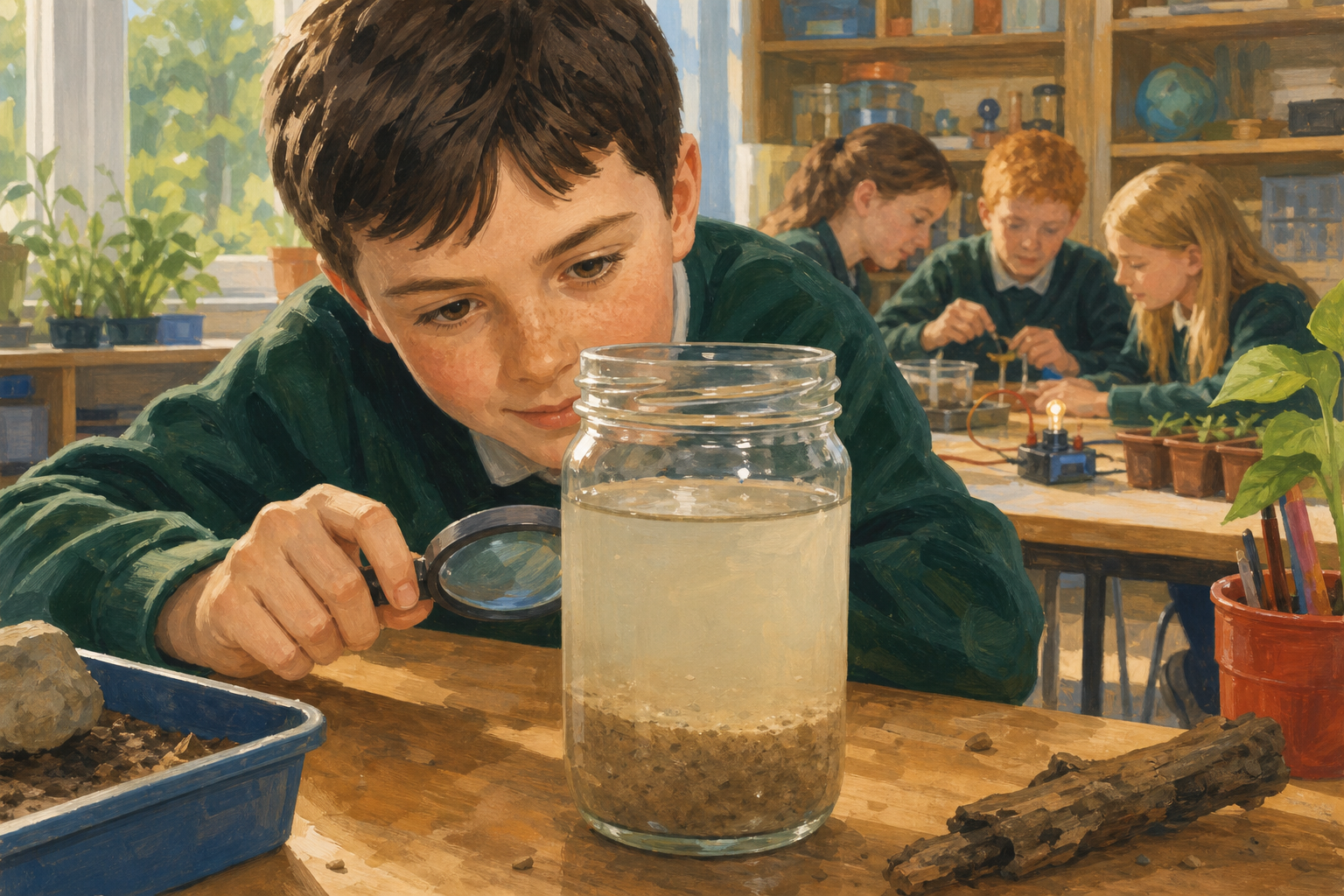
 Your teacher has two jars on the desk. Both hold the same mix of sand, salt and water. One of them is our baseline: poured through nothing, so we can compare every result against it later. How could we get the sand back out of the water, and how would we test a way fairly?
The theme is the same for everyone: separate the sand from the water. Your group chooses which two methods to compare:
- Sieving — pour the mixture through a sieve or colander to catch larger grains
- Filtering — pour through filter paper (or kitchen roll) in a funnel
- Settling — leave the mixture still, then gently pour off the clearer water
A strong testable question sounds like this: Does filtering leave less sand in the water than sieving?
Agree in your group which two methods you will compare and which you think will leave less sand, and why. You will write the full question on your Investigation Journal page in the next step.
Five cards are on the board: the separation method, how much sand is left, amount of mixture, time allowed, the container. Call out where each belongs: Change, Measure, or Keep the same.
That sort is a fair test: change only one thing, measure one result, and keep everything else the same.
Then fill in your Investigation Journal page:
- The two methods you will compare.
- Your prediction, with a because.
- What you will keep the same.
- The same time rule for both methods (for example two minutes still for settling, or pour and wait two minutes before you score).
We all judge “sand left” on the same cloudiness scale: 1 = clear, 5 = as cloudy as the baseline jar.
A cloudiness score is what you saw. Keep that separate from what you think it means when you write later.
Which method leaves the least sand in the water?
Collect only the tools for the two methods your group chose. Run the fair test you planned. Compare each result against the baseline jar (the one poured through nothing). Hold each result cup beside the baseline and score cloudiness from 1 (clear) to 5 (as cloudy as the baseline / very cloudy), same rule for every trial.
Run each method twice (two trials each). Score cloudiness after every trial and write the score on your Investigation Journal page straight away. Keep the amount of mixture, the time rule and the container the same every time.
You’re doing what scientists do: same rules every time, so the numbers can be trusted.
Check your Investigation Journal page. Make sure every trial score is written. Write what you saw (the cloudiness score) in one place and what you think it means in another. Do not mix them up.
Unlock the full learning experience
You're previewing this lesson. Get full access to this lesson and hundreds more — each one ready to teach, with interactive activities, printable resources and pupil progress tracking built in.
This lesson is copyright of DigitalSkills.org 2017 - 2025. Unauthorised use, copying or distribution is not allowed.