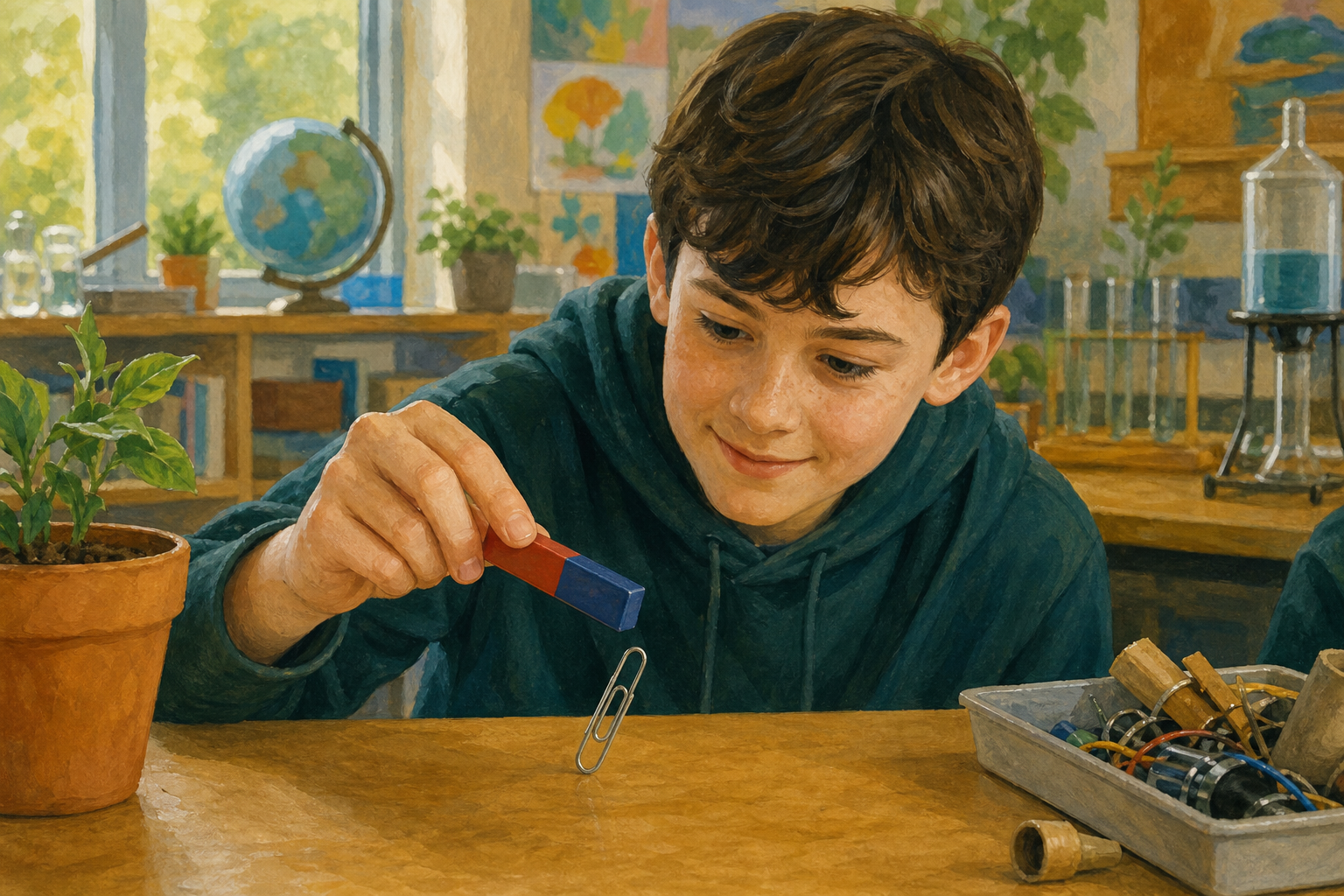
 Watch this. A magnet is held near a paperclip, then near a plastic lid. What do you notice? Why might one jump and the other stay still?
That invisible pull is what we are hunting today. We will test materials with magnets, sort them into two groups, and then compare how strong different magnets are.
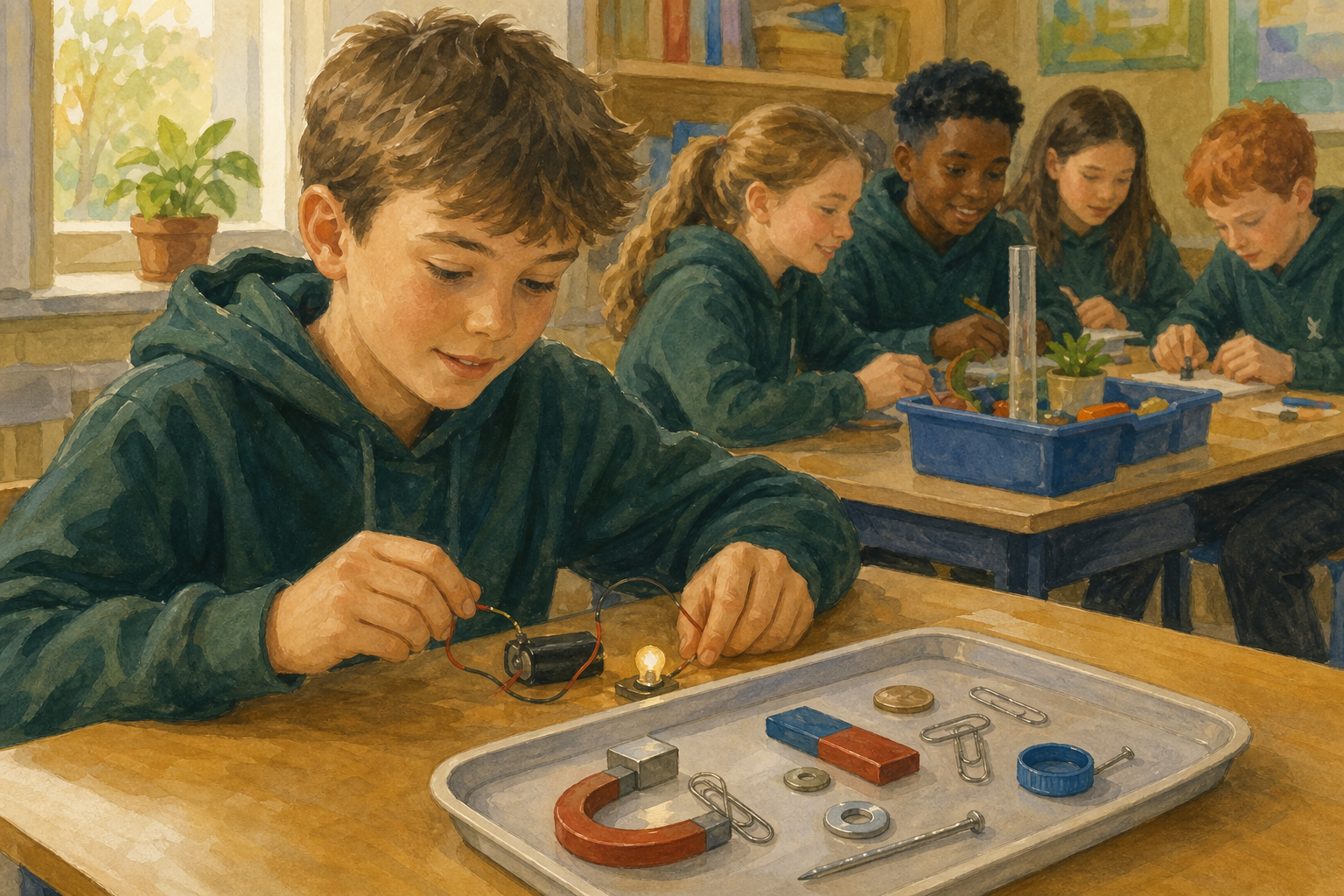 Two words for today's first test:
Magnetic — a material a magnet pulls toward it (like a steel paperclip).
Non-magnetic — a material a magnet does not pull (like a plastic lid).
Hands up if you think every metal is magnetic.
In your group, test each object with the magnet. Hold the magnet close. Does it pull the object?
Sort every object into two piles: magnetic and non-magnetic. As you sort, start your Investigation Journal page: write each material and whether it was magnetic or non-magnetic.
Talk about anything that surprises you before we check together on the board.
Look at the interactive on the board. The items are: paperclip, steel nail, aluminium foil, plastic lid, wooden stick, rubber eraser, copper wire, card.
Call out where each belongs: magnetic or non-magnetic. Use what your group found, not a lucky guess.
Magnetic or non-magnetic?
Two magnets can look alike. Can we prove which pulls harder?
Magnet strength means how strongly a magnet pulls. Our question: Which magnet is strongest?
We change only the magnet. We keep the same: the paperclips, how we start the chain, and how we count.
Paperclip chain method:
- Hang the first paperclip from the magnet.
- Add paperclips one by one to the bottom.
- Stop when the next will not hold or the chain drops.
- Count only the paperclips still hanging.
- Do three trials for each magnet (A then B).
Write each trial number on your Investigation Journal page as you go.
After three trials, put the counts in order from smallest to largest and take the middle value. Example: 5, 8, 6 → ordered 5, 6, 8 → middle value 6.
Predict which labelled magnet will win and why, then run your trials.
Unlock the full learning experience
You're previewing this lesson. Get full access to this lesson and hundreds more — each one ready to teach, with interactive activities, printable resources and pupil progress tracking built in.
This lesson is copyright of DigitalSkills.org 2017 - 2025. Unauthorised use, copying or distribution is not allowed.