Unplugged Lesson
Beginner
40 mins
Teacher led
+100 XP

What you need:
IWB/Projector/Large Screen

Fold-a-Fish: Why Clear Steps Matter

As a teacher, guide your students through a hands-on activity to highlight the importance of clear instructions. Lead them in creating an origami fish, first with vague guidance, then with precise steps, to contrast the outcomes and teach the value of structured directions.
Teacher Class Feed

Load previous activity

    1 - Introduction

    This lesson will help your students distinguish the difference between clear and vague instructions and see how each affects a task's outcome.

    They'll experience this firsthand by attempting to make an origami paper fish.

    First, they'll try to make a paper fish on their own, and then they'll try again with step-by-step instructions.

    Origami is typically done with a Square of paper rather than a typical A4 Rectangle. You could prepare these prior to the class using a guillotine or have each student cut their own page to size during the lesson.

    2 - The Vague Instruction

    Begin by handing each pupil a square of paper. Frame the activity as a fun challenge, emphasising that it's designed to be a bit tricky.

    Without providing any examples, diagrams, or verbal instructions on how to fold, simply state the goal:

    “Your challenge is to fold your square of paper into the shape of a fish. You cannot tear or cut your page and you cannot draw or colour it!”

    Set a visible timer for the entire class (5 minutes should be plenty). During this time, resist the urge to provide any hints. The purpose of this step is to let students experience the frustration and uncertainty that come from a vague instruction!

    Observe how they approach the task—some might experiment randomly, while others might give up quickly. This crucial period of ambiguity will serve as the perfect contrast for the next part of the lesson. If your class has the lesson open on their own screens, ask them to close it until step 4: the folding algorithm is there, and reading it now removes the whole point of this attempt.

    3 - The First Reflection

    After the timer for the first attempt goes off, invite the students to put their paper creations down and gather their thoughts. Before you move on to the next step, guide a brief discussion to capture their immediate feelings and observations.

    Ask them a few key questions to get them to reflect on the process:

    • "How did that feel? What was the hardest part?"

    • "Did anyone feel frustrated or unsure of what to do next?"

    • "What did you need to make the task easier?"

    As students share their thoughts, jot down a few of their key phrases on the board.

    This will serve as a powerful reminder of the problems that arise from a vague instruction, setting the stage for the next part of the lesson where they will receive a clear, ordered algorithm.

    4 - The Clear Instruction

    Hand a fresh square of paper to each student. This time you give them a clear, step-by-step algorithm. Ask them to follow each instruction exactly and not to guess ahead.

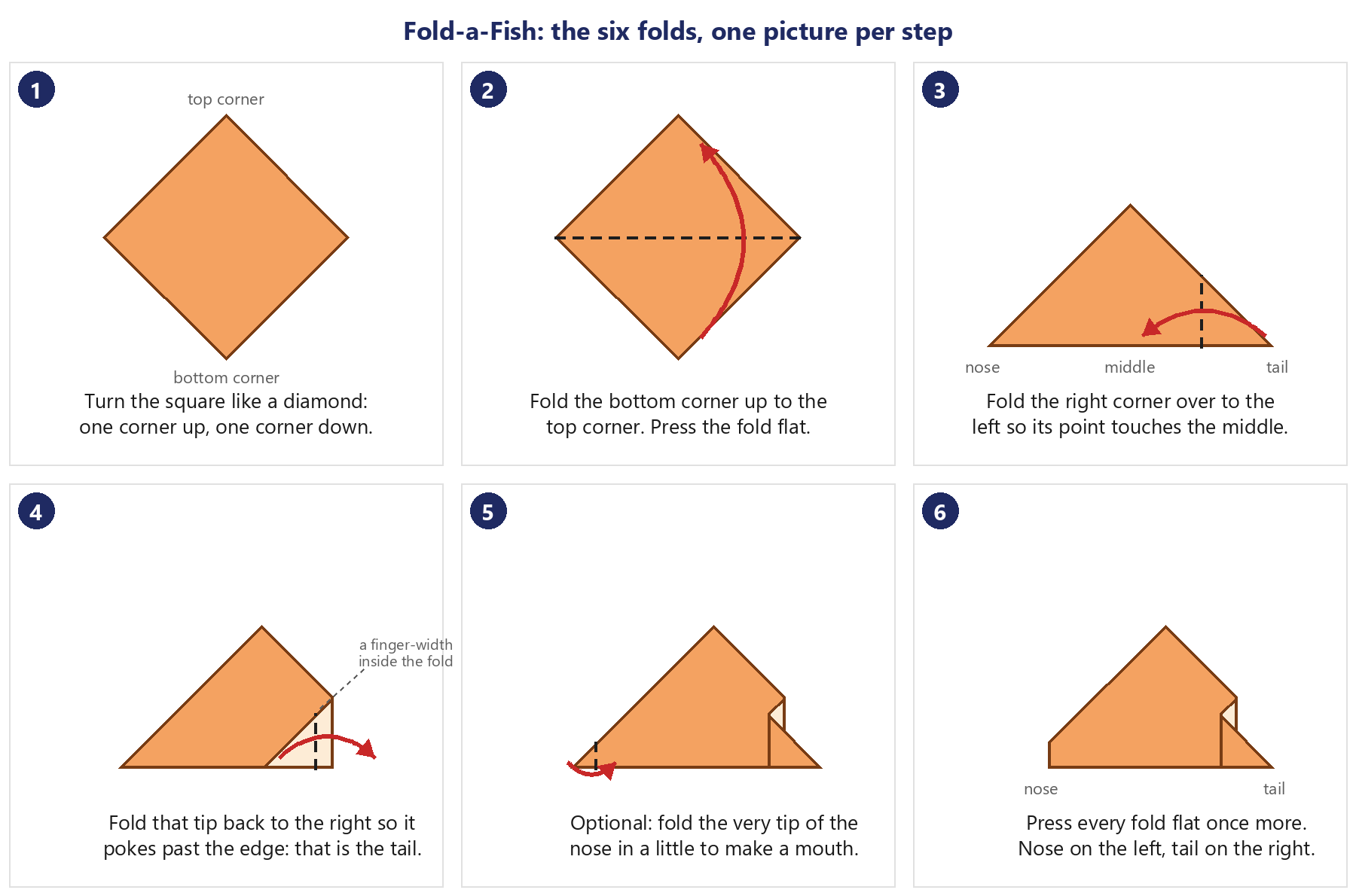
    Read the steps one at a time and pause after each until everyone has caught up. Model each fold with your own paper as you speak. The guide below has one panel per fold, so keep it on the board.

    Fold-a-Fish fold guide: six pictures, one per step

    Simple paper fish, step by step (no cutting, no glue):

    1. Put your square in front of you turned like a diamond, so one corner points up and one corner points down.
    2. Fold the bottom corner up to meet the top corner. Press the fold flat. You now have a triangle: the fold runs along the bottom, with a corner on the left, a corner on the right and a point on top.
    3. The left corner is the fish's nose. Leave it alone. Fold the right corner over to the left so its point touches the middle of the bottom edge. Press the fold flat. This fold line goes straight up and down.
    4. Now fold that same corner back to the right, so its point pokes out past the edge of the fish by about a finger's width. Press the fold flat. That zig-zag is the tail.
    5. Optional: fold the very tip of the nose in a little to make a mouth.
    6. Press every fold flat once more. Nose on the left, tail on the right. Your fish is finished.
    Fold one yourself before the lesson, using the guide above. A 15 cm square works well: on that size the tail sticks out about 3 cm.

    5 - Compare the Two Fish

    Bring the class together to discuss their experience. Invite them to hold up their two finished pieces, putting their first, "guesswork" creation side-by-side with their second, "instruction-based" one.

    Guide the discussion with a few key questions to help them reflect on the process:

    • "Let's talk about how this felt. What was easy about the second time? What was tricky about the first attempt?"

    • "How long did you spend just trying to decide what to do in your first attempt, versus the second?"

    • "What did the clear instructions give you that you didn't have before?"

    As students share their thoughts, jot down 3–4 key phrases on the whiteboard. You'll likely hear things like, "didn’t know where to start," "kept changing my plan," or "it was frustrating." Acknowledging these feelings helps them understand the value of having a clear plan. This is the core takeaway: a clear, ordered algorithm is what turns frustration and confusion into a successful outcome.
    DigitalSkills.org · Online learning platform

    Unlock the full learning experience

    You're previewing this lesson. Get full access to this lesson and hundreds more — each one ready to teach, with interactive activities, printable resources and pupil progress tracking built in.

    Hundreds of curriculum-aligned lessons
    Interactive activities in every lesson
    Printable resources & progress tracking
    Copyright Notice
    This lesson is copyright of DigitalSkills.org 2017 - 2025. Unauthorised use, copying or distribution is not allowed.
    🍪 Our website uses cookies to make your browsing experience better. By using our website you agree to our use of cookies. Learn more